Structural Strengthening & Rehabilitation Services
Extending the life and enhancing the performance of existing structures through advanced engineering
At Arabian Company for Protection and Strengthening, we understand that structures age, loads increase, and environments change. Demolition and rebuilding is not always the most efficient, sustainable, or cost‑effective solution. Our Structural Strengthening and Rehabilitation services are designed to restore, upgrade, and extend the useful life of existing assets—whether they are bridges, buildings, industrial facilities, or heritage structures.
We combine precision diagnostics, advanced materials, and skilled craftsmanship to deliver solutions that address the root cause of deterioration and provide long‑term performance. From concrete repair and carbon fiber strengthening to post‑tensioning and heritage conservation, our engineering‑led approach ensures that every intervention is technically sound, minimally invasive, and built to last.
Our Strengthening & Rehabilitation Philosophy
Every successful rehabilitation begins with understanding the existing structure—its materials, its condition, and its loading history. Our approach follows a systematic engineering protocol:
- Diagnosis: Comprehensive investigation using non‑destructive testing (NDT) to identify all areas of distress and their root causes.
- Analysis: Detailed structural modeling to determine current capacity and required strengthening.
- Design: Selection of the most appropriate strengthening technique, considering structural requirements, constructability, and project constraints.
- Execution: Precise installation by trained technicians using high‑performance materials.
- Quality Control: Rigorous testing and verification to ensure the completed work meets design intent.
Concrete Repair & Restoration
Concrete is the backbone of modern construction, but it is susceptible to degradation over time due to corrosion of reinforcement, chemical attack, mechanical damage, or simply age. Left unaddressed, minor spalls and cracks can lead to major structural issues. Our concrete repair services restore both the appearance and structural integrity of concrete elements.
Spalling & Delamination Repair
When concrete breaks away from the reinforcing steel (spalling) or when internal layers separate (delamination), the structure is compromised and safety is at risk. We follow a rigorous repair protocol:
- Removal: Selective removal of all unsound, cracked, or delaminated concrete using hydro‑demolition or controlled mechanical methods that avoid micro‑fracturing the sound concrete.
- Surface preparation: Cleaning of exposed reinforcement to near‑white metal using abrasive blasting or high‑pressure water.
- Rebar treatment: Application of anti‑corrosion coatings or installation of sacrificial anodes to protect the steel from future corrosion.
- Rebuilding: Placement of high‑performance, low‑shrinkage repair mortars or concretes, built back to the original profile and textured to match adjacent surfaces.
Crack Injection & Sealing
Cracks in concrete can be unsightly, allow water ingress, and in some cases indicate structural distress. We treat cracks based on their nature and cause.
- Epoxy injection: For structural cracks, we inject low‑viscosity epoxy under pressure to bond the cracked concrete back into a monolithic unit, restoring original strength.
- Polyurethane injection: For active or leaking cracks, we inject flexible polyurethane resins that expand on contact with water, forming a permanent, flexible seal.
- Crack stitching: Where cracks indicate ongoing movement, we install stainless steel helical bars across the crack (stitching) to stabilize and reinforce.
Corrosion Damage Repair
Corrosion of reinforcing steel is the leading cause of concrete deterioration. Once chlorides or carbonation reach the steel, rust forms, expands, and causes the concrete to spall. Our approach addresses both the symptoms and the cause.
- Removal of chloride‑contaminated concrete.
- Cleaning and coating of reinforcement with corrosion‑inhibiting primers.
- Installation of discrete sacrificial anodes in repair areas to provide ongoing protection to adjacent steel.
- Rebuilding with low‑permeability, corrosion‑resistant repair materials.
Surface Scaling & Abrasion Repair
Floors, pavements, and industrial slabs often suffer from surface wear due to traffic, chemical exposure, or freeze‑thaw action. We apply high‑strength, abrasion‑resistant toppings that bond to the existing substrate, providing a new, durable wearing surface.
CFRP (Carbon Fiber Reinforced Polymer) Strengthening
Carbon fiber strengthening is a modern, high‑tech solution for upgrading structural elements without adding significant weight or bulk. CFRP materials have a tensile strength five to ten times that of steel, yet they are lightweight, corrosion‑proof, and can be installed with minimal disruption to building occupants.
How CFRP Strengthening Works
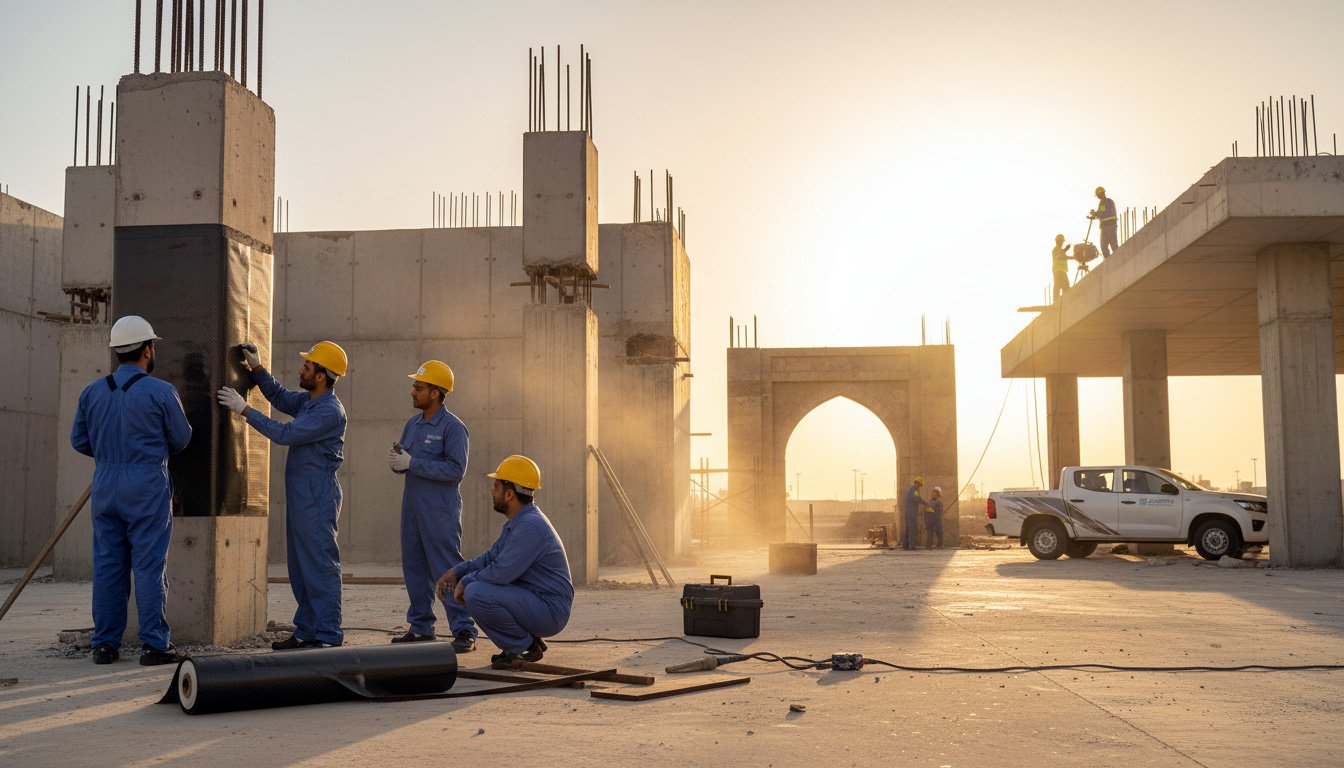
High‑strength carbon fiber sheets, fabrics, or laminates are bonded to the surface of concrete, masonry, or even timber members using high‑strength epoxy resins. The carbon fiber acts as external reinforcement, taking tensile stresses that the original member cannot handle alone. The result is a significant increase in load‑carrying capacity with no change in member size.
Applications of CFRP Strengthening
- Flexural strengthening of beams and slabs: Bonding CFRP laminates or fabrics to the tension face (bottom of beams, top of slabs over supports) to increase moment capacity.
- Shear strengthening of beams: Wrapping CFRP around beams in a U‑shape or fully wrapped to increase shear resistance.
- Column confinement (axial strengthening): Wrapping columns circumferentially with CFRP to increase axial load capacity and ductility—particularly valuable for seismic retrofitting.
- Strengthening of walls: Applying CFRP to masonry or concrete walls to resist out‑of‑plane bending or in‑plane shear.
- Strengthening around openings: Reinforcing areas where new doors or windows have been cut into existing slabs or walls.
Advantages of CFRP Strengthening
- High strength‑to‑weight ratio: Adds negligible weight to the structure.
- Thin profile: Does not increase member size or reduce usable space.
- Corrosion‑proof: Ideal for harsh or marine environments.
- Rapid installation: Minimizes downtime and disruption.
- Versatile: Can be applied to concrete, masonry, timber, and even steel.
Our CFRP Installation Process
- Surface preparation: Grinding or shotblasting to expose aggregate and create a clean, sound substrate.
- Primer application: Application of epoxy primer to penetrate and seal the surface.
- Epoxy saturation: Application of a saturating resin to the prepared surface.
- CFRP application: Placement of carbon fiber fabric or laminates into the wet resin, ensuring full wet‑out and elimination of voids.
- Consolidation: Rolling to remove air bubbles and ensure intimate contact.
- Curing and overcoating: Allowing proper cure, followed by protective coatings if required.
Steel Plate Bonding & Jacketing
For applications requiring significant increases in stiffness or load capacity, steel plate bonding and steel jacketing are proven, reliable techniques. By bonding or mechanically attaching steel plates to existing concrete members, we create composite action that dramatically enhances performance.
Steel Plate Bonding
This technique involves bonding steel plates to the surface of concrete beams, slabs, or columns using high‑strength epoxy adhesives, often supplemented with mechanical anchors for added security.
- Flexural strengthening: Bonding plates to the tension face of beams or slabs to increase moment capacity.
- Shear strengthening: Bonding side plates to beam webs to increase shear resistance.
- Strengthening around openings: Reinforcing areas where new penetrations have been created.
The success of steel plate bonding depends on meticulous surface preparation and strict quality control during adhesive mixing and application.
Steel Column Jacketing
When existing concrete columns need to support significantly higher axial loads or require enhanced seismic performance, we encase them in steel jackets.
- Full steel jacketing: Welding steel plates around the column, then filling the annular space with high‑strength non‑shrink grout. This provides both confinement and additional axial capacity.
- Partial jacketing: Steel angles at corners connected by steel straps—effective for seismic retrofitting.
Advantages of Steel Strengthening
- High capacity increase: Can provide very large strength gains.
- Immediate composite action: Once epoxy cures, steel and concrete act as one.
- Proven technology: A well‑established method with decades of successful use.
- Ductility: Steel jackets significantly improve the ductility of columns, essential for seismic resistance.
Restoration & Heritage Preservation
Saudi Arabia's rich architectural heritage—from mud‑brick palaces of the Najd to historic stone buildings in the Hejaz—requires conservation that respects authenticity while ensuring structural stability. Our heritage preservation services combine traditional craftsmanship with modern conservation science.
Our Conservation Philosophy
- Authenticity first: Retention of original materials and features is always the priority.
- Compatibility: Repair materials must be physically and chemically compatible with historic materials.
- Reversibility: Where modern materials are necessary, they should be removable in the future without harming original fabric.
- Minimal intervention: The least invasive solution that achieves preservation goals is always chosen.
Mud‑Brick (Adobe) Restoration
Mud‑brick architecture requires specialized knowledge. We restore earthen structures using traditional techniques and locally sourced materials.
- In‑situ repair and consolidation of deteriorated mud‑brick.
- Reconstruction of collapsed or severely damaged sections using hand‑formed bricks.
- Application of traditional earth and lime plasters that allow walls to breathe.
- Addressing rising damp and foundation moisture—the primary threat to earthen structures.
Stone & Masonry Conservation
- Repointing: Careful removal of deteriorated mortar and replacement with compatible lime‑based mortars that match the original in strength, color, and texture.
- Stone consolidation: Strengthening friable or decaying stone using specialized consolidants.
- Stone replacement: Where deterioration is irreversible, sourcing matching stone and carving replacements using traditional techniques.
- Cleaning: Gentle removal of soiling, biological growth, and inappropriate previous repairs without damaging the stone.
Structural Stabilization of Historic Structures
We stabilize historic buildings using discreet techniques that preserve their appearance.
- Helical bar stitching: Stainless steel helical bars inserted into masonry to stabilize cracks—completely hidden within the wall.
- Grouting: Low‑pressure injection of compatible grouts to fill internal voids and consolidate rubble cores.
- Discrete tie rods: Hidden tension ties to restrain spreading walls.
Wooden Elements Restoration
- In‑situ repair of historic timber doors, windows, and roof beams.
- Replication of missing carved elements by skilled craftsmen.
- Application of reversible, breathable finishes.
Post‑Tensioning Systems
Post‑tensioning is an advanced method of reinforcing concrete in which high‑strength steel tendons are tensioned after the concrete has hardened, putting the concrete into compression. This active reinforcement allows longer spans, thinner slabs, and superior crack control.
Post‑Tensioning for New Construction
We design, supply, and install post‑tensioning systems for new structures, including:
- Bonded post‑tensioning: Tendons are encased in ducts and, after stressing, grouted to create full bond with the surrounding concrete. Preferred for bridges and structures where redundancy is critical.
- Unbonded post‑tensioning: Tendons are individually greased and sheathed, anchored at each end. Common in buildings and parking structures for faster construction.
- Slab‑on‑grade: Post‑tensioned slabs for industrial floors and residential foundations, controlling cracking and reducing thickness.
External Post‑Tensioning for Strengthening
For existing structures requiring capacity upgrades or correction of excessive deflections, external post‑tensioning is a powerful tool. Tendons are installed outside the original concrete (usually within the beam profile) and stressed to apply beneficial compressive forces.
- Strengthening of bridge girders.
- Correction of sagging in beams and slabs.
- Compensation for prestress losses in aging structures.
Post‑Tensioning Maintenance & Repair
Existing post‑tensioned structures sometimes require inspection and remedial work. We offer specialist services:
- Condition assessment: Visual inspection, sounding, and non‑destructive testing to detect broken strands or corrosion.
- End‑cap re‑greasing: For unbonded tendons where anchor protection has deteriorated.
- Tendon re‑stressing: Where losses are higher than predicted or after structural modifications.
- Replacement of failed tendons: Using external or internal solutions with minimal disruption.
Structural Evaluation & Non‑Destructive Testing
Before any strengthening or rehabilitation work begins, we must understand the existing structure in detail. Our comprehensive evaluation services use advanced non‑destructive techniques to assess condition, identify deterioration, and determine residual capacity—all without damaging the fabric.
Non‑Destructive Testing (NDT) Methods
- Rebound hammer (Schmidt hammer): Estimates concrete compressive strength through surface hardness.
- Ultrasonic pulse velocity (UPV): Measures the velocity of ultrasonic waves through concrete to assess uniformity, detect voids, and estimate strength.
- Cover meter: Locates reinforcement and measures concrete cover depth—critical for assessing corrosion risk.
- Half‑cell potential mapping: Identifies areas where reinforcing steel is actively corroding by measuring electrochemical potentials.
- Resistivity testing: Assesses the corrosion rate potential of concrete.
- Ground‑penetrating radar (GPR): Locates embedded elements and detects voids or deterioration.
- Impact‑echo: Detects voids, delaminations, and thickness in plate‑like structures.
- Carbonation depth testing: Measures how far atmospheric CO2 has penetrated, reducing concrete alkalinity.
- Chloride content analysis: Determines chloride concentration at reinforcement depth to assess corrosion risk.
Load Testing
Where analytical methods are insufficient, we perform proof load tests to verify structural capacity.
- Instrumentation with dial gauges, LVDTs, and strain gauges.
- Controlled application of loads to specified fractions of design loads.
- Real‑time monitoring of deflections and recovery.
- Pass/fail criteria based on deflection and recovery limits.
Structural Health Monitoring
For critical structures or those with ongoing deterioration, we install permanent monitoring systems.
- Strain gauges and vibrating wire sensors.
- Tilt meters and settlement points.
- Corrosion monitoring probes.
- Automated data acquisition with remote access and alarms.
Our Evaluation Process
- Review: Study of existing drawings, design calculations, and maintenance records.
- Visual inspection: Detailed documentation of all visible distress.
- NDT investigation: Selection and execution of appropriate NDT methods.
- Material sampling and laboratory testing: Where required.
- Analysis: Structural modeling and capacity assessment.
- Reporting: Comprehensive report with findings, conclusions, and recommendations.
Why Choose Arabian Company for Structural Strengthening & Rehabilitation?
- Engineering‑led approach: Every project begins with rigorous analysis by qualified structural engineers.
- Advanced materials: We partner with world‑leading manufacturers of CFRP systems, epoxies, and repair materials.
- Skilled workforce: Our technicians are specifically trained and certified in the application of advanced strengthening systems.
- Minimal disruption: We prioritize techniques that are fast, quiet, and clean—essential for occupied facilities.
- Quality assurance: Strict adherence to international standards (ACI, ICRI, PTI) and thorough quality control.
- Comprehensive capability: From initial assessment through design, execution, and long‑term monitoring.
- Proven track record: Successful projects across Saudi Arabia in all sectors.
Contact Our Strengthening & Rehabilitation Team
To discuss how our Structural Strengthening & Rehabilitation services can address your project needs, please contact our engineering team.
Arabian Company for Protection and Strengthening
Email: strengthening@arabiancompany.sa
Phone: +966 13 800 1357
Offices in Riyadh, Jeddah, Dammam, Jubail, and Yanbu
— Restoring strength. Extending life. Ensuring safety. —