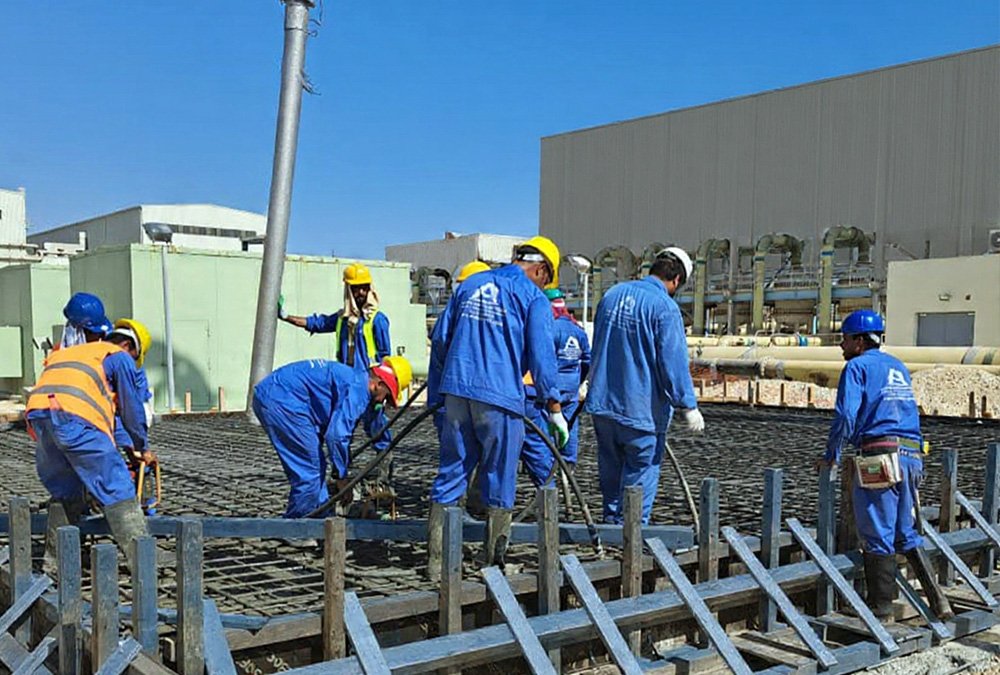
Post-Tensioning Systems
Precision, Strength and Durability for Modern Structures
Overview: The Power of Active Reinforcement
Post-tensioning is one of the most advanced and efficient methods for reinforcing concrete structures. Unlike conventional reinforcement that sits passively until loads are applied, post-tensioning actively compresses the concrete, allowing longer spans, thinner slabs, and crack‑free performance. It is the technology behind iconic bridges, high‑rise buildings, parking structures, and large‑span roofs.
At Arabian Company for Protection and Strengthening, we provide complete post‑tensioning solutions — from design and supply to installation, stressing, and long‑term maintenance. Our engineers and certified crews ensure that every tendon is placed precisely, stressed accurately, and protected against corrosion for the life of the structure.
Why Post‑Tensioning?
Post‑tensioned concrete offers distinct advantages over traditional reinforced concrete:
- Longer spans, fewer columns – ideal for parking garages, auditoriums, and open‑plan buildings.
- Thinner slabs – reduces overall building height and foundation loads.
- Greater crack control – compression keeps concrete tight, improving durability and waterproofing.
- Faster construction – tendons are placed with the reinforcement; stressing follows quickly after concrete gains strength.
- Deflection control – minimises long‑term sagging of slabs and beams.
Our Post‑Tensioning Services
We offer a full spectrum of post‑tensioning capabilities, covering both new construction and the maintenance of existing systems.
1. Design & Engineering
Every successful post‑tensioned structure begins with accurate engineering. Our in‑house structural engineers work alongside project consultants to develop tendon layouts, calculate stressing forces, and detail anchor zones in full compliance with ACI 318, SBC 304, and international codes. We provide:
- Bonded and unbonded system design.
- Loss calculations (short‑term and long‑term).
- Detailed shop drawings and stressing sequences.
- Approval submissions to authorities and consultants.
2. Supply & Installation of Tendons
We supply high‑quality post‑tensioning components from approved manufacturers, including seven‑wire strands, anchorage assemblies, ducts, and grouting materials. Our installation crews are trained to handle:
- Unbonded monostrand tendons – individually greased and sheathed, widely used in buildings and slabs‑on‑grade.
- Bonded multi‑strand tendons – installed inside ducts and later grouted, essential for bridges and heavy transfer beams.
- External tendons – placed outside the concrete cross‑section for strengthening or precast segmental construction.
3. Stressing & Grouting Operations
Precise stressing is critical to achieve the designed forces. We use calibrated hydraulic jacks and pressure gauges, and we record every elongation measurement. For bonded systems, we perform cementitious grouting to protect the strands and create full bond with the structure. Our process includes:
- Calibration of stressing equipment before each project.
- Sequential stressing to avoid overloading members.
- Grouting with low‑bleed, high‑fluidity grout under controlled pressure.
- Preparation of as‑built stressing reports.
4. Post‑Tensioning Maintenance & Repair
Existing post‑tensioned structures sometimes require inspection, monitoring, or remedial work. We offer specialist services to extend the life of older systems:
- Condition assessment – visual inspection, sounding, and non‑destructive testing to detect broken strands or corrosion.
- End‑cap re‑greasing – for unbonded tendons where anchor protection has deteriorated.
- Tendon re‑stressing – where losses are higher than predicted or after structural modifications.
- Replacement of failed tendons – using external or internal solutions with minimal disruption.
5. Strengthening with External Post‑Tensioning
When an existing structure needs increased load capacity or has suffered prestress losses, external post‑tensioning is an elegant solution. We install tendons outside the original concrete (usually inside the beam profile) and stress them to apply beneficial compressive forces. Applications include:
- Bridge girder strengthening.
- Correction of excessive deflections in beams and slabs.
- Compensation for damaged or corroded internal tendons.
The Post‑Tensioning Process – Step by Step
Understanding the workflow helps clients appreciate the precision involved.
Step 1: Tendon Placement
During formwork and rebar installation, post‑tensioning tendons are positioned according to the shop drawings. They are secured to prevent displacement during concreting, with special attention to the profile (height along the member).
Step 2: Concreting & Curing
Concrete is placed carefully around the tendons, avoiding displacement. After placement, curing proceeds until the concrete reaches the required transfer strength (typically 25–30 MPa).
Step 3: Stressing
Once the concrete is strong enough, we insert the stressing jack and tension each tendon to the calculated force. Elongation is measured and compared with theoretical values; any discrepancy is investigated immediately.
Step 4: Anchoring & Seating
The tendon is locked off at the anchorage using wedges. For unbonded systems, the anchor is then greased and capped. For bonded systems, the duct is grouted to protect the steel and create bond.
Step 5: Grouting (Bonded Systems)
Grout is injected under pressure to fill the duct completely, ensuring corrosion protection and full bond between tendon and structure. Grout samples are taken for strength testing.
Step 6: Pocket Closure
The recess left for the stressing jack (pocket) is filled with non‑shrink concrete or mortar, leaving a smooth surface.
Applications of Post‑Tensioning
We have executed post‑tensioning works across a wide range of project types:
- High‑rise buildings – flat plate slabs for residential and office towers.
- Parking structures – long‑span ramps and decks with minimal joints.
- Bridges and overpasses – segmental, cast‑in‑place, and externally post‑tensioned girders.
- Industrial floors and slabs‑on‑grade – heavy‑duty floors with minimal cracking.
- Water tanks and containment structures – circular or rectangular tanks where prestressing prevents leakage.
- Transfer beams and foundations – to distribute heavy column loads.
Quality Assurance & Safety
Post‑tensioning is a high‑precision activity where safety is paramount. Our systems adhere to:
- Saudi Building Code (SBC 304) – concrete structures.
- ACI 318 – building code requirements for structural concrete.
- PTI (Post‑Tensioning Institute) – specifications and guidelines.
- ISO 9001 – quality management procedures.
All stressing equipment is calibrated at certified laboratories, and our crews are trained in safe jacking operations. We enforce strict exclusion zones during stressing and provide protective caps for all permanent anchors.
Frequently asked questions
What interior design services do you offer?
Our interior design services cover everything you need to create a stunning and functional space. From initial concept development and space planning to selecting color schemes, furniture, and custom designs, we bring your vision to life.