Marine & Ports Industry
Protecting critical coastal infrastructure against the harshest marine environment
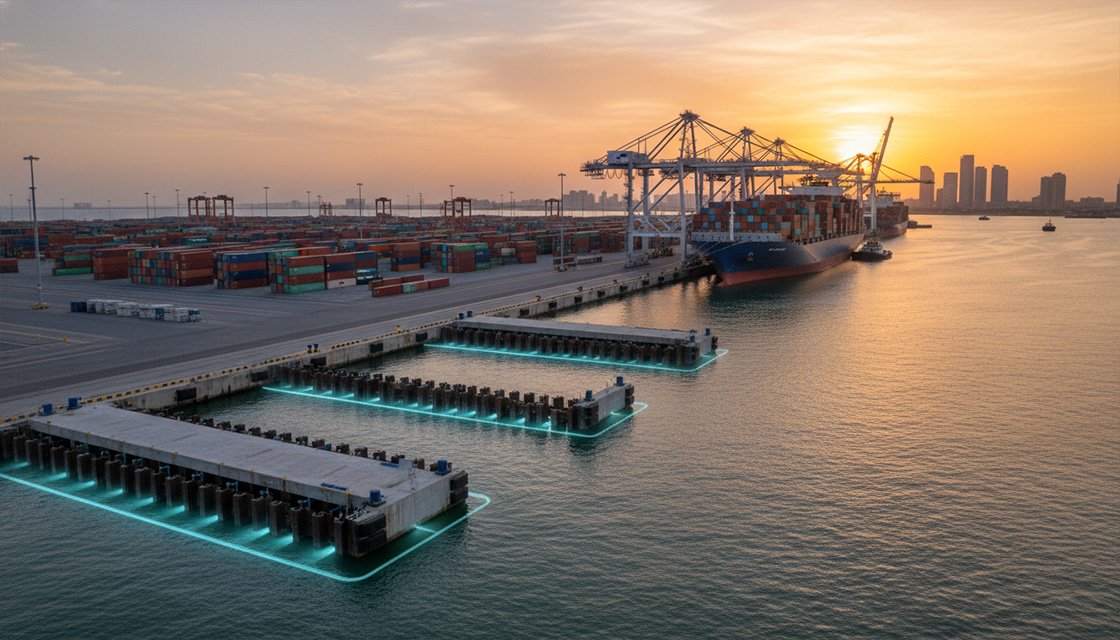
Saudi Arabia's coastline stretches over 2,600 kilometers along the Arabian Gulf and the Red Sea. Along these shores lie the Kingdom's vital ports, terminals, and marine facilities—the gateways for international trade, energy exports, and passenger transport. From the massive container terminals at King Abdulaziz Port in Dammam and the Islamic Port in Jeddah to industrial ports in Jubail and Yanbu and offshore facilities in the Gulf, these assets face the most aggressive natural environment on earth.
At Arabian Company for Protection and Strengthening, we specialize in protecting and extending the life of marine infrastructure. Our engineering-led solutions address the unique challenges of the marine environment: saltwater corrosion, tidal zone attack, wave action, vessel impact, and the relentless combination of wetting and drying. We help port authorities, terminal operators, and marine facility owners maintain safe, operational, and durable assets.
Why Marine & Ports Require Specialized Protection
Marine structures face a unique and aggressive set of degradation mechanisms that demand specialized engineering solutions.
- Chloride-induced corrosion: Saltwater penetrates concrete and attacks reinforcing steel, causing rapid deterioration.
- Splash zone attack: The area between high and low tide experiences the most aggressive corrosion due to continuous wetting and drying.
- Marine growth: Barnacles, algae, and other organisms accelerate surface deterioration and hide underlying damage.
- Vessel impact and abrasion: Berthing ships and moving cargo cause mechanical damage to fendering systems and structure edges.
- Steel corrosion: Sheet piles, piles, and structural steel in marine environments corrode rapidly without protection.
- Concrete deterioration: Chemical attack from seawater, sulfate attack, and alkali-aggregate reactions.
- Scour: Erosion of seabed around foundations from tidal currents and propeller wash.
- Freeze-thaw (in some regions): Though less common in Saudi Arabia, some marine structures face temperature cycling.
Our Services for the Marine & Ports Industry
We deliver comprehensive protection, strengthening, and durability solutions tailored to the specific needs of marine infrastructure.
Cathodic Protection (CP)
Cathodic protection is the most effective technology for stopping corrosion of steel in marine environments. We design, supply, install, and maintain CP systems for all types of marine structures.
Impressed Current Cathodic Protection (ICCP)
- Applications: Steel sheet piles, reinforced concrete piles, offshore platforms, ship hulls, and buried pipelines.
- Components: Mixed metal oxide (MMO) titanium anodes, reference electrodes, transformer/rectifier units, and remote monitoring systems.
- Advantages: Adjustable current output, long anode life (40+ years), suitable for large structures.
Galvanic (Sacrificial) Cathodic Protection
- Applications: Offshore jacket legs, boat hulls, small jetties, splash zone protection, and localized areas.
- Anode materials: Aluminum, zinc, or magnesium alloys selected for the specific marine environment.
- Advantages: No external power required, simple installation, low maintenance, reliable.
Our CP Process for Marine Structures
- Site investigation: Water resistivity measurements, structure-to-electrolyte potential surveys, current density requirements.
- Detailed engineering design: Anode sizing, spacing, and configuration optimized for the specific structure.
- Supply and installation: Underwater installation by divers or surface installation during construction.
- Commissioning: Verification of protection criteria (typically -800 mV to -1100 mV Ag/AgCl).
- Monitoring and maintenance: Regular potential surveys, anode replacement programs, remote monitoring options.
Industrial Coating & Lining for Marine Environments
Protective coatings are the first line of defense for marine steel and concrete. We apply high-performance systems designed for the most aggressive coastal and submerged conditions.
Steel coatings
- Zinc-rich primers: Sacrificial protection for carbon steel in atmospheric and splash zones.
- Epoxy intermediate coats: High-build barrier protection against water and chlorides.
- Polyurethane and polysiloxane topcoats: UV stability and color retention for above-water structures.
- Glass flake reinforced coatings: Enhanced barrier properties for immersion service.
Concrete coatings
- Anti-carbonation coatings: Breathable coatings that prevent CO2 and chloride ingress.
- Epoxy coatings: For splash zones and areas requiring chemical resistance.
- Penetrating sealers: Hydrophobic treatments that repel water while allowing vapor transmission.
Specialized marine coating applications
- Splash zone coatings: High-build, abrasion-resistant systems for the most aggressive zone.
- Anti-fouling coatings: Prevents marine growth on submerged surfaces (where specified).
- Tank linings: For ballast tanks, potable water tanks, and fuel storage on marine structures.
All marine coating work follows stringent surface preparation standards (NACE No. 2/SSPC-SP10 near-white metal blast) and is applied by certified applicators.
Concrete Repair & Restoration
Concrete marine structures deteriorate rapidly once chloride-induced corrosion begins. We restore integrity and extend service life.
Repair of chloride-contaminated concrete
- Hydro-demolition: Selective removal of deteriorated concrete without micro-fracturing sound concrete.
- Rebar cleaning and treatment: Removal of corrosion products, application of anti-corrosion coatings.
- Sacrificial anode installation: Embedding zinc anodes in repair areas to protect adjacent steel.
- High-performance repair mortars: Polymer-modified, low-permeability materials designed for marine environments.
Crack injection
- Epoxy injection: Structural rebonding of cracks in beams, piles, and decks.
- Polyurethane injection: Flexible sealing of active cracks and water stops.
Pile and beam repair
- Pile jacketing: Encasing deteriorated piles in fiberglass or steel forms filled with high-strength grout or concrete.
- Section enlargement: Adding reinforced concrete to damaged beams and piles.
- CFRP wrapping: Carbon fiber reinforcement for additional strength and corrosion protection.
Structural Strengthening for Marine Structures
Increased vessel sizes, heavier cargo handling equipment, and aging infrastructure often require load capacity upgrades.
CFRP strengthening
- CFRP wrapping of piles: Increases axial capacity and provides corrosion protection.
- CFRP laminates for beams: Flexural strengthening of crane beams and deck structures.
- Advantages in marine: Corrosion-proof, lightweight, minimal addition to structural weight.
Steel plate bonding
- Epoxy-bonded steel plates for significant flexural capacity increases.
- Mechanically anchored steel for impact areas.
Post-tensioning
- External post-tensioning for strengthening existing marine structures.
- Replacement of corroded or failed tendons.
Scour Protection & Foundation Stabilization
Erosion of seabed around piles and foundations compromises structural stability. We protect against scour and stabilize affected foundations.
- Riprap and armor stone placement: Large stones placed around foundations to resist erosion.
- Grout mattresses: Fabric forms filled with grout to create flexible, permeable scour protection.
- Underwater grouting: Injection of grout to fill voids created by scour.
- Resin injection: Expanding polyurethane resins to stabilize loose seabed soils.
- Sacrificial concrete mattresses: Precast concrete units for permanent scour protection.
Fendering Systems & Marine Accessories
Protecting vessels and structures during berthing requires properly designed and maintained fendering systems.
- Fender installation and replacement: Rubber, foam-filled, and pneumatic fenders of all types.
- Fender panel repair: FRP and steel facing panel restoration.
- Bollard and mooring hardware: Installation, strengthening, and replacement.
- Ladder and access platform installation: Marine-grade materials for long life.
Underwater Inspection & Non-Destructive Testing
Regular inspection is essential for identifying deterioration before it compromises safety. Our diving and NDT teams provide comprehensive underwater assessments.
Underwater inspection services
- Commercial diving: Certified divers for visual inspection and measurement.
- ROV inspection: Remotely operated vehicles for deep or hazardous areas.
- Underwater video and photography: High-definition documentation.
- Underwater thickness measurement: Ultrasonic testing of steel piles and sheet piles.
Non-destructive testing (NDT) for marine structures
- Half-cell potential mapping for corrosion activity.
- Cover meter surveys for reinforcement location.
- Ultrasonic pulse velocity (UPV) for concrete quality.
- Impact-echo for void detection.
- Chloride sampling and analysis.
Passive Fire Protection for Port Facilities
Ports handle hazardous materials and fuels. We provide fire protection for critical structures and equipment.
- Structural steel fire protection: Intumescent coatings for crane structures, buildings, and pipe supports.
- Firestop systems: Sealing penetrations in fire-rated walls and floors within port buildings.
- Jet fire protection: Specialized systems for high-risk areas such as fuel transfer zones.
Standards & Compliance
We adhere to international and Saudi standards for marine structures and protection systems.
- Saudi Building Code (SBC).
- Saudi Aramco standards: SAES-H-001 (Cathodic Protection), SAES-H-002 (Coating).
- Mawani (Saudi Ports Authority) requirements.
- Royal Commission for Jubail and Yanbu standards.
- NACE/AMPP: Corrosion control and coating standards.
- ISO 12944: Corrosion protection of steel structures by protective paint systems.
- PIANC (World Association for Waterborne Transport Infrastructure) guidelines.
- ACI 562: Concrete repair code.
- IMO and SOLAS: International maritime safety standards where applicable.
Typical Marine & Port Assets We Serve
- Commercial container terminals and general cargo wharves.
- Bulk cargo and dry bulk terminals (grain, cement, aggregates).
- Liquid bulk terminals (oil, gas, petrochemicals).
- Ro-Ro (roll-on/roll-off) terminals.
- Industrial port facilities (Jubail, Yanbu, Ras Al-Khair).
- Offshore supply bases and service jetties.
- Ship repair and shipbuilding facilities.
- Marinas and small craft harbors.
- Offshore platforms and jackets.
- Navigation aids and lighthouse structures.
- Coastal protection structures (revetments, breakwaters).
- Desalination plant intake and outfall structures.
- Cooling water intake structures for power plants.
Why Port & Marine Operators Choose Arabian Company
- Specialized marine expertise: Our engineers and divers understand the unique challenges of marine corrosion and deterioration.
- Turnkey capability: From underwater inspection and condition assessment through design, execution, and long-term monitoring.
- Minimal operational disruption: We plan work around vessel movements and port operations, utilizing night shifts and phased execution.
- Underwater capabilities: Our commercial diving team performs inspections, installations, and repairs below the waterline.
- Long-term solutions: We design for durability, not just temporary fixes.
- Safety culture: Rigorous adherence to port safety protocols, permit-to-work systems, and diving safety standards.
- Proven track record: Successful projects at major Saudi ports and marine facilities.
Case Study Highlight: Cathodic Protection Upgrade – King Abdulaziz Port, Dammam
Client: Saudi Ports Authority (Mawani)
Scope: Design and installation of impressed current cathodic protection for steel sheet pile wharves at multiple berths.
Challenge: Existing CP system had reached end of life; corrosion was progressing rapidly in the tidal zone. Work had to proceed without disrupting port operations.
Solution: Installation of MMO titanium anodes on the sheet piles, new transformer/rectifier units with remote monitoring, and reference electrodes for continuous potential measurement. Work was phased by berth, coordinated with vessel schedules.
Outcome: All berths now achieve full cathodic protection criteria (-950 mV Ag/AgCl). Remote monitoring allows instant verification of system performance. Projected extension of wharf life: 30+ years.
Case Study Highlight: Concrete Pile Repair – Industrial Port, Jubail
Client: Royal Commission for Jubail and Yanbu
Scope: Repair of severely deteriorated concrete piles supporting a major cargo wharf.
Challenge: Chloride-induced corrosion had caused extensive spalling and section loss in the splash zone. Piles were load-bearing and critical to wharf operation.
Solution: Underwater inspection and marking; hydro-demolition of deteriorated concrete; installation of sacrificial zinc anodes in repair areas; pile jacketing with fiberglass forms and high-strength, low-permeability grout; application of anti-carbonation coating above splash zone.
Outcome: All 48 piles restored to full structural capacity. Wharf returned to full operation. Ongoing monitoring shows no further corrosion activity.
Case Study Highlight: Fender System Replacement – Islamic Port, Jeddah
Client: Terminal operator
Scope: Replacement of damaged and deteriorated fendering system at a busy container terminal.
Challenge: Vessels up to 400m length required reliable fendering; work had to be completed between ship calls with minimal berth downtime.
Solution: Pre-fabrication of new fender assemblies off-site; rapid removal and installation during scheduled berth windows; load testing of new fenders; coating of steel components with marine-grade systems.
Outcome: New fendering system installed with zero unscheduled berth closures. Vessel operators report improved berthing safety.
Contact Our Marine & Ports Team
To discuss how Arabian Company can protect and strengthen your marine infrastructure, please contact our dedicated Marine & Ports sector team.
Arabian Company for Protection and Strengthening
Email: marine@arabiancompany.sa
Phone: +966 13 800 5566
24/7 Emergency Response for Marine Facilities: +966 50 333 4455
Offices in Dammam, Jubail, Jeddah, and Yanbu – positioned to serve the Kingdom's entire coastline.
— Protecting the gates to the Kingdom's commerce —